
Fixture vs Personal Property: What Stays or Goes?
One of the most common closing day surprises is when a buyer expects something to stay, and the seller expects to take it. That confusion almost always comes back to one question: is it a fixture or personal property?

What is a Fixture in Real Estate?
A fixture in real estate is any physical property that is permanently attached (annexed) to the land or a building in such a way that it becomes part of the real property. Legally, fixtures are expected to “convey” or stay with the home during a sale, whereas personal property is movable and stays with the seller.
This guide explains how fixtures are treated in a home sale, how personal property is handled, and how to prevent disagreements by writing clear terms into the contract.
Quick Comparison: Fixture vs Personal Property
| Feature | Real Estate Fixture | Personal Property |
|---|---|---|
| Attachment | Permanently attached/bolted | Movable/Free-standing |
| Default Rule | Stays with the home (Conveys) | Goes with the seller |
| Example | Ceiling Fan, Chandelier | Floor Lamp, Area Rug |
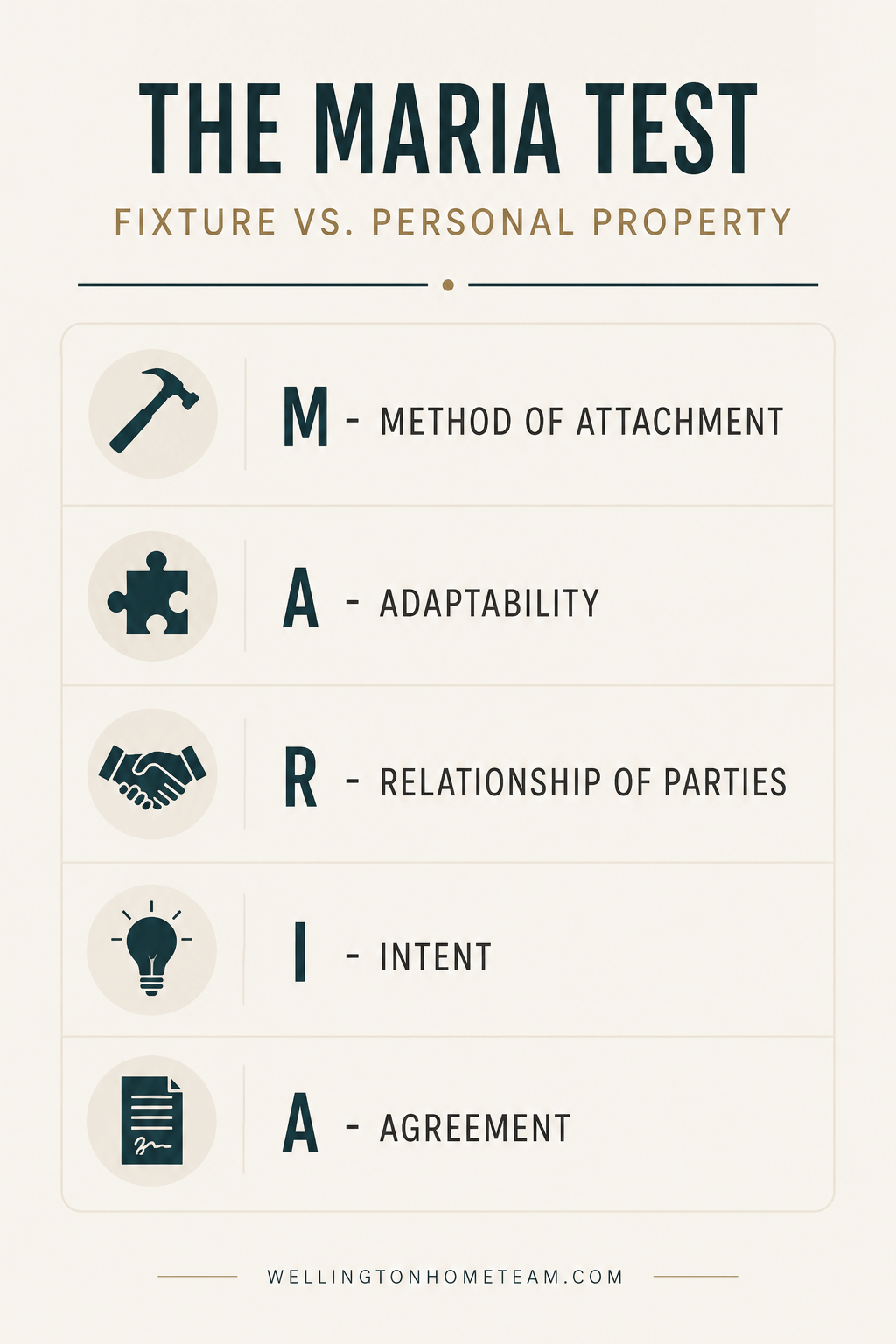
How to Tell if Something Is a Fixture: The MARIA Test
In the real estate industry, we use a five-part legal test known as MARIA to determine if an item has legally become a fixture:
- M – Method of Attachment: Is the item nailed, bolted, or glued? If removing it causes damage or leaves holes in the wall or ceiling, it’s legally a fixture.
- A – Adaptability: Was the item custom-made or adapted for the home? Examples include custom-fit window shutters or built-in bookshelves.
- R – Relationship of Parties: This is a legal “tie-breaker.” If a dispute goes to court, judges often favor the buyer over the seller to ensure the home’s value is protected.
- I – Intent: Was the item originally installed with the intention of making a permanent improvement?
- A – Agreement: The most important part! What does the written contract say? The contract always overrides the other four factors.
Why This Matters in a Real Estate Contract
Buyers often decide they want a home because of features they see during showings, like upgraded lighting, a mounted TV, custom window treatments, a garage storage system, or a backyard gazebo. Sellers may view some of those same items as personal belongings they plan to take.
The best way to avoid problems is simple: write it down. If a buyer wants an item to stay, it should be included in the offer or an addendum. If a seller wants to remove an item a buyer might assume stays, it should be excluded in writing.
Detailed Examples: Fixture vs Personal Property
To help you navigate your next transaction, here is a deep dive into common items that cause confusion during home sales.
Kitchen & Appliances
- Built-in oven or built-in microwave: Usually a fixture because they are integrated into the cabinetry.
- Freestanding range: Often treated as personal property unless included, depending on the contract and local norms.
- Refrigerator: Commonly personal property unless included.
- Dishwasher: Almost always a fixture because it is connected to both plumbing and cabinetry.
If the appliances are important to the buyer, do not rely on assumptions. Include the exact items in the offer and confirm them again during inspections and the final walkthrough.
Lighting, Fans, and Smart Home Items
- Light fixtures and ceiling fans: These are the “classic” fixtures. If they are hardwired, they stay.
- Smart thermostats: Often treated as fixtures, but sellers sometimes swap them back to original units before closing.
- Doorbell cameras and exterior cameras: Often treated as fixtures if mounted and wired, but the safest approach is to specify them.
- Wall-mounted TVs: Usually personal property, while the wall mount itself is treated as a fixture in many cases. Specify both.
Window Treatments
- Blinds: Commonly fixtures because they are custom-sized and screwed into the frame.
- Curtain rods: Often treated as fixtures because they are installed and attached to the wall.
- Drapes/curtains: Often treated as fixtures in Florida and typically stay with the home unless excluded in writing.
This is a frequent source of frustration because buyers remember how a room looked staged. If you want the rods and drapes, write both into the contract.
Garage and Storage
- Wall-mounted shelving systems: Often fixtures if anchored, but specify them anyway.
- Freestanding cabinets: Usually personal property.
- Overhead storage racks: Often treated as fixtures if bolted into framing.
- EV chargers: Increasingly common in South Florida and frequently a source of confusion. A hardwired Level 2 charger is typically treated as a fixture; a plug-in unit is personal property. Because sellers often install these at personal expense and buyers may assume they stay, it is best to specify them explicitly in the contract.
Outdoor Items
- In-ground landscaping: Usually part of the property.
- Potted plants: Personal property unless included.
- Playsets: Can be either, depending on how permanently installed they are. Specify.
- Gazebos/pergolas: Often depends on whether they are anchored and wired. Specify.
- Pool equipment: Typically part of the property, but do not use vague wording. List the vacuum, cover, and tools separately.
Security Systems and Solar
These items can become complicated because of leases, financing, and monitoring contracts.
- Hardwired security components: Often fixtures.
- Monitoring contracts: Separate from the equipment and not automatically transferred.
- Solar panels: May be owned, financed, or leased. The contract should address ownership and transfer terms clearly.
How to Prevent Fixture Disputes Before Closing
Use a Simple “In or Out” Approach
If an item matters to the buyer, list it as included. If a seller plans to take something that a buyer might reasonably expect to stay, list it as excluded. This prevents misunderstandings and keeps negotiations cleaner.
Be Specific, Not General
Avoid wording like “pool equipment included” because it can be interpreted in more than one way. If the buyer wants the robotic cleaner, heater, child safety fence, or specific accessories, list them individually.
Confirm During the Walkthrough
Final walkthroughs are not just about checking repairs. They are also where buyers verify that included items are still present and in the expected condition. If something is missing, it is better to address it before closing.
Take Photos During Showings
If there are items a buyer wants to stay, photos help everyone stay aligned. They reduce “I thought you meant the other one” problems.
Fixture vs Personal Property FAQs
Are light fixtures considered fixtures in real estate?
In most transactions, built-in light fixtures and ceiling fans are treated as fixtures that convey with the home unless excluded in writing.
Is a wall mount a fixture?
A wall mount is often treated as a fixture if it is anchored to the wall. The TV itself is typically personal property. If either matters, specify both items in writing.
Do sellers have to leave appliances?
Not always. Some appliances are commonly included and others are commonly excluded, and this can vary by contract and local norms. If the buyer wants specific appliances, they should be written into the offer as included items.
Are curtain rods fixtures?
Curtain rods are often treated as fixtures because they are installed and attached to the wall. Drapes and curtains are also commonly treated as fixtures in Florida and typically stay with the home unless the seller excludes them in writing.
What is the easiest rule of thumb?
If a buyer would be upset if it was gone on closing day, put it in writing as included. If a seller plans to take something that might look “part of the house,” put it in writing as excluded.
Final Thoughts
Fixture vs personal property issues are preventable. The winning strategy is to remove ambiguity early by clearly listing what stays and what goes. When expectations are written into the contract, closing is smoother and both sides avoid last-minute conflict.
Not sure what stays with a home sale? Learn the difference between fixtures and personal property so there are no surprises at closing. #realestateAbout the Author
Wellington Realtor Michelle Gibson has specialized in residential real estate since 2001 in Wellington, Florida and surrounding areas. If you are buying or selling and want clear guidance on contract details, inspections, and negotiation strategy, reach out any time.

This was a really informative post! I never realized how important it is to distinguish between fixtures and personal property in real estate transactions. Your examples helped clarify things a lot. Thanks for the insights!