
COA vs. HOA vs. CDD in Florida: Fees and Key Differences
If you are buying a home in Florida, especially in a newer or master-planned community, you have probably come across at least one of these three acronyms: HOA, COA, and CDD. Many buyers assume they all mean the same thing, or that they are interchangeable. They are not. Each one represents a different legal structure, a different fee, and a different impact on your monthly budget. Understanding the distinction before you make an offer can save you from a very unpleasant surprise at closing.
Quick Answer
An HOA (Homeowners Association) is a private association that manages a neighborhood, enforces deed restrictions, and charges monthly or quarterly dues.
A COA (Condominium Owners Association) governs condominiums — typically covering building maintenance, exterior insurance, and shared elements — also funded by monthly dues.
A CDD (Community Development District) is a government entity that finances community infrastructure through municipal bonds and is repaid annually through your property tax bill — not a separate monthly payment.
When comparing HOA vs. CDD in Florida, the key difference is that an HOA manages community rules and amenities, while a CDD finances infrastructure and is paid through property taxes — they serve entirely different purposes and often exist side by side in the same community. Many buyers searching for HOA vs CDD Florida are surprised to learn they are not interchangeable and that both often apply to the same home. If you are comparing neighborhoods, our Wellington communities guide shows how these fees vary from one neighborhood to another.
Side-by-Side Comparison
Here is how COA, HOA, and CDD compare across the dimensions that matter most to buyers:
COA
Condo Owners Association
Private non-profit. Governs condominiums. Covers the building exterior, roof, shared walls, and common elements — often including master insurance and some utilities.
HOA
Homeowners Association
Private non-profit. Governs single-family neighborhoods and subdivisions. Enforces deed restrictions and maintains shared amenities like pools, gates, and parks.
CDD
Community Development District
A government entity — not a private corporation. Finances and manages community infrastructure via municipal bonds, repaid through your annual property tax bill.
| Feature | COA | HOA | CDD |
|---|---|---|---|
| Legal nature | Private non-profit | Private non-profit | Government entity |
| Florida statute | Chapter 718 | Chapter 720 | Chapter 190 |
| How you pay | Monthly / quarterly dues | Monthly / quarterly dues | Annual property tax bill |
| Covers building exterior / roof | Usually yes | Rarely | No |
| Florida Sunshine Laws | No | No | Yes — fully public |
| Board elected by | Unit owners | Homeowners | County Supervisor of Elections |
| Mandatory closing disclosure | Yes | Yes | Yes |
COA: Condominium Owners Association
A Condominium Owners Association governs condominium buildings or complexes where individual owners hold title to a specific unit, and everyone shares ownership of the common elements. COAs are governed by Florida Chapter 718, one of the most detailed and heavily regulated statutes in Florida community association law.

What You Actually Own in a Condo
When you buy a condo, you own the interior air space of your unit as defined in the declaration of condominium — sometimes called a “box of air.” Everything beyond that boundary — the roof, exterior walls, hallways, elevators, pool, and grounds — is owned collectively by all unit owners as common elements. This shared ownership structure is why condo fees tend to run higher than HOA dues. If you are weighing a condo purchase against a single-family home, understanding what to know before buying a condo in Florida is an important first step.
What COA Dues Cover
Monthly condo dues typically bundle the building’s master insurance policy, exterior maintenance, roof reserves, common area utilities, landscaping, management fees, and capital replacement reserves. Unlike an HOA homeowner, a condo owner generally does not need to insure the exterior or roof — only the interior via an HO-6 policy. How well those reserves are funded determines whether a special assessment is in your future — our guide to condo reserve funds walks through exactly what to look for.
Buyer Tip — COA
Always request the association’s most recent budget, reserve study, and meeting minutes before making an offer on a condo. A low monthly fee paired with a thin reserve fund is a leading predictor of a future special assessment. Florida’s post-2021 condo safety legislation also requires structural integrity reserve studies on certain buildings — ask whether this has been completed before you close.
HOA: Homeowners Association
The Homeowners Association is the most familiar structure for most buyers and the dominant form of community governance across Florida’s single-family and townhome neighborhoods. HOAs are governed by Florida Chapter 720. For a deeper look at how they work in this market specifically, our Wellington HOA guide covers what most buyers want to know before committing to a community.
What an HOA Actually Does
An HOA is a private, non-profit corporation created by a developer when a community is built. As the community matures, control transfers to a homeowner-elected board of directors. That board enforces the Covenants, Conditions, and Restrictions (CC&Rs) — the deed restrictions that bind every owner regardless of when they purchased. This means the HOA governs exterior paint colors, fence styles, landscaping standards, parking, pet policies, and use of shared amenities. Before committing to any HOA community, it is worth understanding the pros and cons of buying a home with an HOA so you go in with clear expectations.
HOA Ownership: You Own the Lot and Structure
In an HOA community, you own your lot and home outright. The HOA owns the common areas — clubhouse, pool deck, entry features, parks — and grants residents use rights. You are responsible for your own building’s insurance, roof, and structure. This is the fundamental distinction from condo ownership.
Key 2024 Florida HOA Changes
Landmark legislation, effective July 1, 2024 added meaningful homeowner protections. Associations must now provide 14 days’ written notice and a genuine opportunity to cure a violation before any fine can be issued. The law also placed new restrictions on board member conduct and significantly increased financial transparency requirements.
Buyer Tip — HOA
HOA fees vary dramatically by community. Request the most recent audited financials and reserve study, and ask directly whether any special assessments are pending or planned. A well-funded reserve is the clearest sign of a well-run association — and the best protection against an unexpected bill after closing.
CDD: Community Development District
The CDD is the structure that surprises Florida buyers most often — and the one most commonly misunderstood in the Wellington and Palm Beach County market.
A CDD is a Government Entity, Not a Corporation
Unlike an HOA or COA, both private corporations, a Community Development District is a special-purpose local government entity created under Chapter 190 of the Florida Statutes by city or county ordinance. It has the legal authority to levy taxes, issue tax-exempt municipal bonds, and operate as a unit of local government within a defined boundary. Because it is a government entity, all board meetings are publicly noticed and open to anyone, not just residents, and all financial records are fully public.

Why Developers Use CDDs
Building a master-planned community from raw land requires enormous upfront capital — roads, water and sewer infrastructure, stormwater systems, street lighting, parks, and amenities can cost tens of millions before a single home is built. A CDD lets the developer finance that infrastructure through tax-exempt bonds, spreading the cost over 20 to 30 years and repaying it through annual assessments on residents’ property tax bills.
Two Components of a CDD Assessment
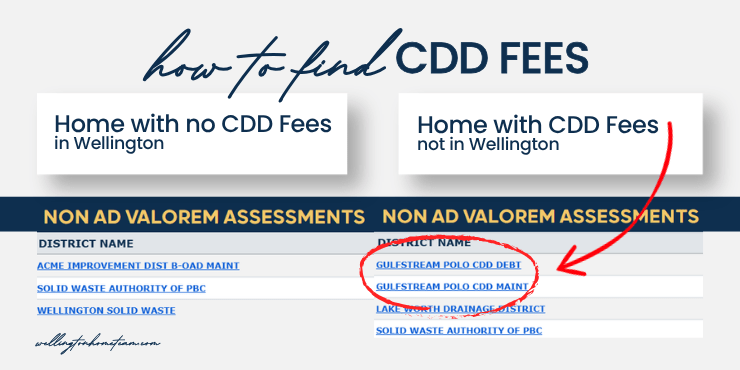
CDD assessments have two distinct parts. The capital (debt service) portion repays the bonds used to build the infrastructure, which decreases as the debt is paid down and disappears entirely when the bonds are retired. The operations and maintenance (O&M) portion covers the ongoing upkeep of what the CDD owns and remains after the bonds are paid off. When you see a CDD on a property tax bill, it is labeled clearly by district name, for example, “Gulfstream Polo CDD Debt” and “Gulfstream Polo CDD Maint” appearing as two separate line items in the Non-Ad Valorem Assessments section.
Important — CDD fees appear on your property tax bill
Your CDD assessment is not a separate monthly payment. It is billed annually as part of your county property tax statement under the Non-Ad Valorem Assessments section. When your lender calculates monthly escrow, the CDD assessment should be included — but not all lenders handle this automatically. Always verify with your lender before closing so your true monthly payment is never understated.
When HOA + CDD or COA + CDD Overlap
In many of Florida’s newer master-planned communities, buyers encounter both a CDD and an HOA. These are complementary layers with different functions. The CDD finances and maintains the infrastructure: roads, drainage, utilities, and often the community’s signature amenity complex. The HOA enforces aesthetic standards and community rules. You pay both.
When modeling your true monthly cost of ownership, add your HOA dues to the monthly equivalent of your annual CDD assessment (annual CDD ÷ 12) before comparing any two properties on price.
Real-World Cost Example
Here is how HOA and CDD fees combine in a typical Florida master-planned community. These figures are illustrative; actual fees vary by community and are updated annually.
Example: New construction home with HOA + CDD
$285 / mo
$3,600 / yr
$300 / mo
$585 / mo
A community advertising a “$285/month HOA” may carry an additional $300/month in CDD costs — nearly doubling the true community fee. This is one of the most common sources of sticker shock for buyers who do not ask the right questions up front.
Resale advantage in CDD communities
A resale home in a mature CDD community may carry a meaningfully lower capital assessment than a brand-new home in the same district, because the bonds have been partially paid down. Always ask for the current outstanding bond balance when comparing resale to new construction — it can represent significant long-term savings.
What Wellington Buyers Actually See on Their Property Tax Bill
This is where buyers in the Wellington area often get confused and where a little education goes a long way. Every Palm Beach County property tax bill has two sections: Ad Valorem Taxes (your standard property taxes, calculated based on your home’s assessed value) and Non-Ad Valorem Assessments (flat fees that are the same regardless of what your home is worth). A CDD fee, if one exists, always appears in the Non-Ad Valorem section, and it will always say “CDD” in the district name.
Wellington homeowners commonly see these non-ad valorem line items on their annual tax bill, and it is important to understand that none of these are CDDs:
| District name on your bill | What it actually is |
|---|---|
| Wellington Solid Waste | The Village of Wellington’s fee for trash and recycling collection. Paid by virtually all Wellington homeowners. |
| Solid Waste Authority of PBC | Palm Beach County’s fee for waste disposal. A county-wide charge separate from Wellington’s collection fee. |
| Acme Improvement District | A water control and drainage district that manages canals and water control structures across much of Wellington. A special district — but not a CDD. |
| Lake Worth Drainage District | A regional drainage district covering parts of Palm Beach County. Another special district — not a CDD. |
These are legitimate special district fees, and they do add to your annual tax bill, but they are fundamentally different from a CDD. They are not tied to developer bonds, they do not have a debt service component that disappears over time, and they are not unique to any specific community. A CDD, by contrast, is community-specific, clearly labeled with the district name and “CDD” in the title, and split into debt and maintenance components.
The bottom line for Wellington buyers
CDDs are more common in newer master-planned developments in unincorporated Palm Beach County, communities built from raw land where a developer needed bond financing to put in the roads, utilities, and amenities before a single home was sold. As you evaluate any property in the Wellington area, the lookup process below will tell you in about 60 seconds exactly what non-ad valorem assessments apply, and whether any of them are a CDD.
How to Find Out if a Property has a CDD Step-by-Step
You do not need to call anyone or wait for a disclosure. The Palm Beach County Property Appraiser’s website gives you a definitive answer for any property in about 60 seconds. Here is exactly how to do it:
Go to the Palm Beach County Property Appraiser
Visit pbcpao.gov(opens in new tab) and use the property search to find the home by address.
Open the property detail page
Click on the property from the search results to open the full detail record. Scroll down to the Taxes section — you will see a summary showing Ad Valorem and Non-Ad Valorem totals.
Click “Property Tax Details”
This button is at the bottom of the Taxes section. It opens a popup showing every line item on the tax bill, broken into Ad Valorem Taxes and Non-Ad Valorem Assessments.
Scroll to the Non-Ad Valorem Assessments section
This section lists every special district assessment by name. Look at the District Name column. If any line contains the word “CDD” in the name — such as “Gulfstream Polo CDD Debt” or “Gulfstream Polo CDD Maint” — the property is in a CDD district.
No “CDD” in any district name? No CDD.
If the Non-Ad Valorem section shows only items like Wellington Solid Waste, Acme Improvement District, Lake Worth Drainage District, or Solid Waste Authority of PBC — those are standard Wellington assessments, not CDDs. The property does not have a CDD fee.
Buyers weighing fees against amenities often find that Wellington’s gated communities vary significantly in what their HOA dues actually cover — from basic gate access to full resort-style amenity packages. For buyers who prefer to avoid association fees altogether, there are also non-HOA communities in Wellington worth exploring.
Questions to Ask Before You Make an Offer
Whether you are buying a condo, a resale in an established neighborhood, or new construction in a master-planned community, get answers to these questions before you write an offer:
| Question | Why it matters |
|---|---|
| Is there a COA, HOA, CDD, or a combination? | Your total monthly cost could include multiple payments. Model the full picture before comparing homes on price. |
| What are the current fees for each? | A modest list price can be offset significantly by high combined community fees. |
| Is there a pending special assessment? | A vote to replace the roof or repave roads could mean a large unexpected bill shortly after closing. |
| What are the reserve fund balances? | Underfunded reserves are the leading predictor of future special assessments. |
| What is the CDD bond balance and maturity date? | The capital assessment disappears when bonds are retired — resale homes in mature CDDs may carry lower fees than new construction in the same district. |
| Are there rental restrictions? | HOAs and COAs can restrict leasing frequency and duration — this matters for investment flexibility. |
| Has the association had recent litigation? | Ongoing lawsuits can affect association finances and your ability to secure certain loan types. |
| Has the COA completed its structural integrity reserve study? | Florida’s post-2021 condo safety law requires this for certain buildings. If not completed, it may signal deferred maintenance risk. |
Frequently Asked Questions
Is a CDD the same as an HOA?
No — they are fundamentally different. A CDD is a government entity created under Florida Chapter 190. It finances infrastructure through tax-exempt municipal bonds and is repaid through your annual property tax bill. An HOA is a private corporation under Florida Chapter 720 that enforces deed restrictions and manages amenities, funded by monthly or quarterly dues. Many Florida communities have both, serving entirely different purposes. Treating them as the same is one of the most common and costly mistakes buyers make when evaluating total ownership costs.
Are CDD fees included in property taxes?
Yes — but not in the traditional property tax sense. A CDD fee is a non-ad valorem assessment, meaning it is not based on your home’s value. It appears as a separate line item in the Non-Ad Valorem Assessments section of your annual Palm Beach County tax bill. Many lenders include it in monthly escrow alongside your regular property taxes, but not all do automatically. Always confirm with your lender before closing.
What is the difference between a COA and an HOA?
A COA governs condominiums under Florida Chapter 718. You own only the interior of your unit — the COA maintains the building exterior, roof, and all common elements. An HOA governs single-family neighborhoods under Florida Chapter 720. You own your lot and home outright, and the HOA enforces deed restrictions and maintains shared amenity areas only. The scope of responsibility is far broader in a COA, which is why fees tend to be higher.
Can I have a CDD fee and an HOA fee on the same home?
Yes — and this is common in Florida’s master-planned communities, especially with new construction. The CDD handles infrastructure financing billed annually through property taxes. The HOA handles deed restrictions and amenity operations billed monthly or quarterly. They serve different purposes and are paid through different channels. Always factor both into your monthly cost calculation before comparing homes on price.
Does a resale home in a CDD community still have a CDD fee?
Yes — the CDD assessment runs with the land and transfers to every subsequent owner until the bonds are fully retired. However, a resale home in a mature CDD community may carry a lower capital assessment than a brand-new home in the same district because the bonds have been partially paid down. This is a meaningful financial advantage resale can offer over new construction. Always ask for the current outstanding bond balance when comparing the two.
What is the difference between Acme Improvement District and a CDD?
This is one of the most common points of confusion for Wellington buyers. Acme Improvement District is a water control and drainage district that manages canals and water control structures across a large portion of Wellington. It is a special district — but it is not a Community Development District under Chapter 190. It does not involve developer bonds, it does not have a debt service component that eventually disappears, and it is not tied to any specific residential community. If you see Acme on a property tax bill, you are not looking at a CDD fee.
What happens if I don’t pay my HOA or COA dues?
Both HOAs (Chapter 720) and COAs (Chapter 718) can levy late fees and interest on unpaid assessments and record a lien on your property. That lien can complicate or prevent a future sale. In certain circumstances, both can pursue foreclosure to satisfy the debt, governed by strict statutory procedures and typically a last resort after other collection efforts have been exhausted.
What is the difference between a regular and a special assessment?
Regular assessments are the predictable monthly or annual dues you budget for in advance. A special assessment is an additional one-time charge levied when the association needs funds not covered by the operating budget — an unexpected major repair, a capital project the reserves cannot fully cover, or a legal settlement. Requesting a current reserve study before purchase is the most effective protection.
Are CDD meetings open to the public?
Yes. As a government entity, a CDD must comply with Florida’s Sunshine Laws. All board meetings must be publicly noticed and open to anyone — not just residents. Budgets, meeting minutes, and financial records are fully public documents. Attending a CDD meeting before buying is one of the best ways to assess the governance and financial health of a community you are considering.
Final Thoughts
Much of what makes Florida’s planned communities so desirable — the resort-style amenities, gated security, and beautifully maintained streetscapes — is funded by the structures outlined above. HOAs, COAs, and CDDs each serve a distinct purpose, and together they deliver the community experience that defines these neighborhoods.
The key for buyers is understanding which structures apply to a given home, what you are paying for, and how those costs integrate into your true monthly ownership budget. And with the Palm Beach County Property Appraiser lookup process outlined above, you have a simple, reliable way to verify any property before you make an offer — no guessing, no relying on what the listing says.
Working with an agent who knows the specific fee structures, governing documents, and community histories of the neighborhoods you are considering makes all the difference. The right home is not just about the square footage it is about the total picture of what it costs and how you will live there.
Ready to find your community
Have questions about a specific neighborhood?
Every community has its own fee structure, governing documents, and history.
Get the full picture before you make an offer.
This article is for educational purposes only and does not constitute legal or financial advice. Florida statutes are subject to change. Always consult a licensed Florida real estate professional or attorney for guidance specific to your situation.