
Apartment Complex vs Private Landlord: What Renters Need to Know
Choosing between an apartment complex and a private landlord is one of the biggest decisions a renter makes, and it goes far beyond monthly rent. Move in costs, credit requirements, property types, and even how you apply can look completely different depending on which route you choose. Understanding these differences upfront can save you hundreds of dollars and a lot of frustration during your search.
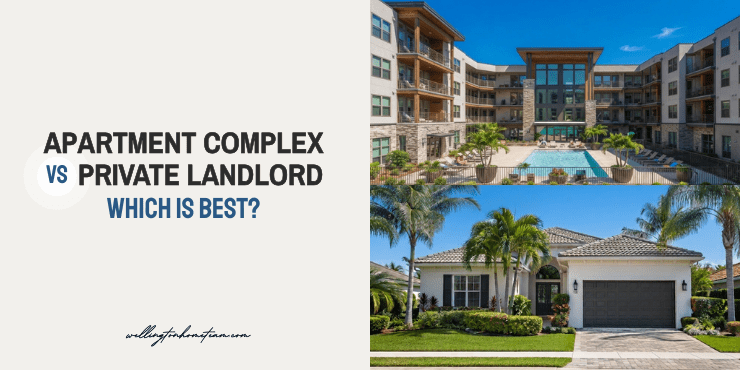
After helping renters find homes throughout Palm Beach County for more than two decades, we have seen both apartment complexes and private landlords work well depending on a renter’s finances, credit history, and long-term goals. The best choice depends less on which option is “better” and more on which fits your situation.
Below, we break down the key differences so you can decide which option fits your budget, credit profile, and lifestyle.
Apartment Complex vs Private Landlord at a Glance
| Factor | Apartment Complex | Private Landlord |
|---|---|---|
| Move In Costs | Usually lower upfront | Often first, last, and security |
| Monthly Rent | Usually higher | Often lower |
| Credit Requirements | More flexible | Often stricter |
| Negotiation | Rare | Often possible |
| Screening Fees | New fee every application | Sometimes reusable screening report |
| Property Types | Apartments (condo or townhome style) | Homes, condos, duplexes, townhomes |
| Amenities | Pool, gym, maintenance | Varies by owner |
| HOA Approval | No | Possibly, if the property is in an HOA |
Move In Costs: Upfront Fees Add Up Differently
One of the biggest surprises for renters is how differently move in costs are structured between the two options.
Most private landlords require first month’s rent, last month’s rent, and a security deposit equal to one month’s rent. That means a renter could be paying the equivalent of three months’ rent just to get the keys.
Apartment complexes typically only require first month’s rent and a security deposit, and that deposit amount is often based on your credit score. A strong credit score could mean a low, flat deposit, while a lower score could mean a deposit equal to a full month’s rent, or sometimes more.
Here is where it gets tricky. Apartment complexes usually charge higher monthly rent than private landlords, but their lower move in costs make them look more affordable at first glance. This is exactly why some renters get stuck. They budget for the lower upfront cost of an apartment complex, sign the lease, and then realize the higher monthly rent stretches their budget more than a private landlord’s higher move in cost would have.
Before signing anywhere, calculate your true first year cost. Add up the move in fees plus twelve months of rent for each option. That number tells the real story, not just the sticker price of the deposit.
Credit Requirements: Who Is More Flexible
Credit requirements are another major difference between the two paths.
Private landlords tend to want higher credit scores because they typically do not have the same financial cushion or corporate backing that a management company has. A missed rent payment affects them directly, so many are stricter about who they approve.
Apartment complexes, which are often run by a property management company rather than an individual owner, tend to be more flexible with credit. Many use a tiered system where your credit score determines your deposit amount rather than an automatic denial. Someone with a lower score might still get approved, just with a higher deposit or a slightly higher monthly rate.
If your credit is still a work in progress, an apartment complex may give you more paths to approval. If your credit is strong, you may have an easier time negotiating with a private landlord.
Property Type: What You Are Actually Renting
The physical property itself tends to differ significantly between the two options, and this is one of the biggest factors that separates renting from an individual owner from renting through an apartment management company.
Private landlords often offer:
- Single-family homes
- Villas
- Condos
- Duplexes
- Townhomes
- Guest houses
Apartment complexes generally offer:
- Studio apartments
- One-bedroom apartments
- Two-bedroom apartments
- Three-bedroom apartments
Apartment complexes are usually condo style or townhome style units, built and managed as part of a larger community with shared amenities like pools, gyms, or on site maintenance staff. Private landlords can offer nearly any type of property, which gives renters going the private rental vs apartment route more variety, but it also means less consistency in quality, amenities, and management responsiveness.
The HOA Factor With Private Landlords
Here is a layer many renters do not think about until they run into it. If a private landlord’s property is located within a Homeowners Association, or HOA, that adds an entirely separate approval process on top of the landlord’s own requirements.
HOAs often run their own background and credit checks, separate from the landlord’s screening. This can mean an additional application fee on top of the one you already paid the landlord, along with the HOA’s own criteria around credit score, criminal history, and sometimes even income verification.
So while a private landlord rental might seem simpler on the surface, an HOA can add cost, time, and another set of hurdles to clear before you are approved to move in.
The Application and Screening Process
The way your application is screened can also work in your favor, or against you, depending on which route you take.
Many real estate agents use third party screening platforms, such as RentSpree, to run credit, criminal, and eviction checks. Most private landlords who work with agents will accept one of these reports, which means if you are denied by one private landlord, you may be able to reuse that same report to apply elsewhere without paying for a new screening every time.
Apartment complexes are different. Almost every complex runs its own proprietary rental screening process. That means every time you apply to a new complex, you are paying a new application fee for a new screening, even if you were just denied somewhere else. If you get denied at an apartment complex, that application fee is gone, and you will need to pay it again at the next property.
This is an important budgeting consideration if you are applying to multiple places at once. Applying to several apartment complexes can get expensive fast, while applying to multiple private landlords through an agent using the same screening report can save you money. For a full walkthrough of what the process looks like locally, see these steps to renting a home.
Rent Negotiation: Fixed Pricing vs Room to Negotiate
Rent at an apartment complex is typically the rent. There is very little room to negotiate the listed price, though some complexes may offer move in specials or waived fees during slower leasing seasons.
Private landlords tend to have more flexibility. Because you are dealing directly with an individual owner rather than a corporate pricing structure, you can often submit an offer, much like you would when making an offer to purchase a home. This gives you room to negotiate not just the rent itself, but also fees, move in dates, lease length, or even whether a security deposit can be split into payments.
If negotiation matters to you, a private landlord generally gives you more leverage than an apartment complex will.
Hidden Costs to Watch For
The advertised rent is rarely the full picture, no matter which option you choose. Before applying, ask about these possible extra charges:
- Application fees
- HOA application fees
- Pet fees or pet rent
- Parking fees
- Amenity fees
- Utility billing or utility administration fees
- Trash fees
- Move-out cleaning charges
Apartment complexes tend to itemize these fees clearly in a fee schedule, while private landlords may mention them individually during the leasing conversation. Either way, ask for a full list of fees before you apply, not after.
What Happens at Lease Renewal
Most renters focus entirely on the first lease and forget to think about what happens after it ends. Apartment complexes often use pricing software that can lead to significant rent increases at renewal, since pricing is set at the portfolio level rather than by an individual person. Private landlords may be more willing to negotiate renewal terms if you have been a reliable tenant, since keeping a good tenant in place often costs them less than finding a new one.
Before you sign your first lease, ask how renewal pricing typically works. It can tell you a lot about your total cost over two or three years, not just the first twelve months.
Maintenance and Repair Response Times
How quickly a repair gets handled can make a real difference in your day to day living experience.
Apartment complexes typically offer:
- On-site maintenance staff
- Emergency maintenance lines
- Online maintenance request portals
Private landlords vary more widely. Response time depends heavily on the individual owner, whether they use outside contractors, and how many properties they manage. This can mean faster, more personal service, or it can mean a slower response if the landlord is difficult to reach, which matters most for urgent issues, like pipes bursting.
Pros and Cons of Renting From an Apartment Complex
Pros
- Lower upfront costs
- On-site amenities
- Professional management
- Easier approval for a wider range of credit scores
Cons
- Higher monthly rent
- Less flexibility overall
- Little room to negotiate
- Rent increases at renewal are common
Pros and Cons of Renting From a Private Landlord
Pros
- Lower monthly rent
- Negotiable terms
- More housing options
- A direct, personal relationship with the owner
Cons
- Higher move-in costs
- May require a stronger credit history
- Maintenance quality can vary
- HOA approval may apply
Apartment Complex vs Private Landlord: Which Should You Choose?
Apartment complexes may be a better fit if you:
- Have limited money for move-in costs
- Have average or below-average credit
- Want amenities like a pool, gym, or clubhouse
- Need maintenance issues handled quickly
A private landlord may be a better fit if you:
- Want a lower monthly payment
- Have excellent credit
- Want room to negotiate rent or fees
- Need a single-family home rather than an apartment
- Prefer dealing directly with the owner instead of a landlord vs property management company setup
Before You Apply to Any Rental
- Check your credit score before you apply
- Calculate your total move-in costs, not just the deposit
- Budget for utilities separately from rent
- Ask about pet fees up front
- Verify whether HOA approval is required
- Read the full lease before signing anything
- Understand how renewal pricing typically works
Frequently Asked Questions
Is it cheaper to rent from an apartment complex or a private landlord?
It depends on the timeframe. Apartment complexes usually have lower move in costs but higher monthly rent, while private landlords usually have higher move in costs but lower monthly rent. Calculating a full year of costs for each option gives you the true comparison.
Do apartment complexes require better credit than private landlords?
Not necessarily. Many apartment complexes use a tiered system where credit score affects your deposit amount rather than resulting in an automatic denial, which can make them more flexible than private landlords who often expect higher credit scores upfront.
Why do private landlords ask for first, last, and a security deposit?
Private landlords often do not have the same financial cushion as a management company, so collecting first month’s rent, last month’s rent, and a security deposit upfront helps protect them if a tenant stops paying or breaks the lease early.
Can I reuse my credit and background check for multiple applications?
If your report was run through a third party platform like RentSpree, many private landlords working with agents will accept it, which can save you from paying a new application fee each time. Apartment complexes typically require their own separate screening for every application.
Can I negotiate rent with a private landlord?
Yes, in many cases. Private landlords often have more flexibility to negotiate rent, fees, move in dates, or lease terms, similar to submitting an offer on a home purchase. Apartment complexes generally have fixed rent with little to no negotiation.
Does an HOA affect renting from a private landlord?
Yes. If the property is in a Homeowners Association, the HOA may require its own separate application, fee, and screening process in addition to the landlord’s own requirements, which can add extra cost and time to move in.
Which is easier to get approved for, an apartment complex or a private landlord?
Apartment complexes are often easier to get approved for because many use a tiered credit system that adjusts your deposit rather than denying you outright. Private landlords may set stricter minimum credit requirements since they do not have the same financial cushion as a management company.
Final Thoughts
Neither option is automatically better. If your priority is keeping the apartment application process simple, minimizing upfront costs, and accessing amenities, an apartment complex may be the better fit. If your goal is a lower monthly rent, more flexibility, or renting a single-family home, a private landlord could offer better long-term value. Comparing the total first-year cost, understanding each property’s apartment approval requirements, and asking the right questions before signing a lease will help you choose the rental that is right for your needs.
If you found this helpful, feel free to share: Apartment Complex vs Private Landlord: Which Is Best?
Comparing move in costs, credit requirements, and rent terms between apartment complexes and private landlords to help you choose the better fit. #apartments #homesforrent #realestateAbout the Author
Michelle Gibson is a Realtor with Hansen Real Estate Group Inc. and has specialized in residential real estate since 2001 in Wellington, Florida, and nearby communities. She has guided hundreds of transactions from contract to closing and has handled complex inspections, low appraisals, HOA issues, and financing delays firsthand. She helps buyers and sellers make confident decisions with clear guidance on pricing, negotiations, inspections, and closing timelines.
Areas of service include Wellington, Lake Worth, Royal Palm Beach, Boynton Beach, West Palm Beach, Loxahatchee, Greenacres, and surrounding areas.